WEEKLY OCEAN NEWS
WEEK FOUR: 21-25 September 2015
For Your Information
- The Autumnal Equinox --The Autumnal
Equinox will occur early this coming Wednesday morning
(officially at 0821Z on
23 September 2015 or 4:21 AM EDT or 3:21 AM CDT, etc.). At that time the
noontime sun will appear directly above the equator, representing one
of the two times during the year for such an occurrence, with the other
being at the vernal equinox in March. The term "equinox" arises from
the fact that this time of year represents "equal night" and equal day
essentially everywhere. Within the subsequent several days, the length
of daylight will become noticeably shorter. This decrease in daylight
will continue for another three months to the winter solstice during
the evening of Monday, 21 December 2015.
Editor's note: John White, a meteorologist from
North Carolina involved with the AMS Education program, reported that
the geosynchronous (or geostationary) satellites make an "satellite
eclipse" of the sun near the spring and autumnal equinoxes because of
their equatorial orbit, such that these satellites pass through the
earth's shadow and the satellite is powered down when the solar array
does not receive sufficient sunlight. [For more information, consult NWS
Southern Region GOES Satellite FAQ] EJH.
If you checked the sunrise and sunset times in your local newspaper or from the climate page at your local National Weather Service Office, you would probably find that not until the midpoint of this coming week will the length of time when the Sun is above the local horizon would be precisely 12 hours at most locations. However; the length of night will exceed that of the length of daylight by the end of the week. The effects of atmospheric refraction (bending of light rays by the varying density of the atmosphere) along with a relatively large diameter of the sun contribute to several additional minutes that the Sun appears above the horizon at sunrise and sunset. - Perigean spring tide to occur next weekend with a supermoon -- The moon will reach full moon phase next Sunday evening at 10:50 PM EDT and 9:50 PM CDT or officially at 0250 Z on 28 September 2015. This full moon will occur on the same day as perigee, when the moon is closest to Earth in its elliptical orbit. The closeness of the moon and increased gravitational pull will cause an increase in the height of ocean tides, resulting in what is called a "perigean spring tide" (or King Tide) over next weekend. [NOAA National Ocean Service News]
Since the moon will come within 221,765 miles of Earth, it is called a "supermoon," as its closeness would make the moon appear larger than usual. Furthermore, a lunar eclipse will occur on Sunday evening, which is the first time a lunar eclipse will occur with a supermoon in more than 30 years [NASA Goddard Space Flight Center Feature]
- September is National Preparedness Month -- The month of September has been declared National Preparedness Month (NPM), which is aims to educate and empower Americans to prepare for and respond to all types of emergencies, including natural disasters. NPM is sponsored by the Federal Emergency Management Administration (FEMA), which has provided a toolkit of marketing materials to help promote the month, is the lead on this campaign that was originally launched in 2004. The theme for 2015 NPM is "Don't Wait. Communicate. Make Your Emergency Plan Today." During Week 4 (20-26 September), the weekly hazard-focused theme is "Power Outage." [FEMA's Ready.gov] NOAA's National Weather Service is working with FEMA to communicate the importance of emergency preparedness as a key component of its Weather-Ready Nation campaign. [NOAA Weather Ready Nation]
- Reconstructing past oceanic conditions from marine
sediment cores -- If you would like information on how
scientists can reconstruct past environmental conditions in the oceans
from the analysis of the physical, chemical and geological data in
deep-sea sediment cores, please read this week's Supplemental
Information…In Greater Depth.
- Remembering Hurricane Hugo -- Last year the National Weather Service Forecast Office in Charleston, SC created a website with video series and an interactive map that commemorated the 25th anniversary of the landfall of Hurricane Hugo, a massive category 4 hurricane (on the Saffir-Simpson Scale). At the time, Hugo was the strongest hurricane to strike the United States in more than 20 years and it also was the the nation's costliest hurricane on record, with an estimated $7 billion in damage. As many as 26 deaths were attributed to Hugo in the US, Puerto Rico and the US Virgin Islands. [NOAA Weather-Ready Nation News]
Ocean in the News
- Eye on the Tropics -- During the last week tropical cyclone activity continued in the Atlantic and Pacific basins of the Northern Hemisphere:
- In the North Atlantic basin, Tropical Depression 9 formed between the Cape Verde Islands and the Lesser Antilles during the middle part of last week. This tropical depression traveled toward the north and then to the west-northwest during the latter part of the week before dissipating this past Saturday approximately 800 miles to the of the east-northeast of the Lesser Antilles.. Satellite images and additional information on Tropical Depression 9 can be found on the NASA Hurricane Page.
Tropical Storm Ida, the
ninth named tropical cyclone of the
2015 Atlantic hurricane season, formed from a tropical depression early last Saturday morning (local time) over the eastern Atlantic approximately 900 miles to the west of the Cape Verde Islands. This tropical storm traveled toward the west-northwest across the central tropical Atlantic over the past weekend. By Sunday afternoon, Tropical Storm Ida was approximately 1100 miles to the east of the Leeward Islands. Forecasts indicate gradually strengthening as Ida was expected to continue toward the west-northwest early this week.
- In the central North Pacific basin, Tropical Depression 5-C formed far to the west of the Hawaiian Islands south of the French Frigate Shoals late last Friday afternoon (local time). Over the weekend this tropical depression traveled slowly northward. Forecasts indicate that Tropical Depression 5-C could strengthen early this week as it would travel toward the north.
- In the western North Pacific basin,
Tropical Storm Vamco made landfall along the central coast of Vietnam to the south of Da Nang last Monday (local time). After making landfall, this tropical storm quickly dissipated. See the NASA Hurricane Page for satellite images and additional information on Tropical Storm Vamco.
Typhoon Krovanh formed from a tropical depression during the first half of last week to the east-northeast of Saipan. By late in the week, Krovanh had intensified to a category 3 typhoon on the Saffir-Simpson Scale as it traveled toward the northwest before curving toward the north and then to the northeast. As of Sunday, Krovanh weakened to a tropical storm as it passed approximately 600 miles to the southeast of the northern Japanese islands. Additional information and satellite images for Typhoon Krovanh are available on the NASA Hurricane Page.
- Reassessing National Hurricane Center forecasts made for Tropical Storm Erika -- Forecasters from NOAA's National Hurricane Center recently posted a blog that represents an evaluation and reassessment of the forecasts they and their colleagues in the media made on Tropical Storm Erika during the last week of August. Some criticism had been voiced as to the accuracy of the forecasts and to the media's apparent overreaction to Erika. [NOAA National Hurricane Center Official blog]
- Tsunami waves from recent major Chilean earthquake reach Japan -- One day after a major 8.3 magnitude earthquake off the coast of central Chile triggered a tsunami, small tsunami waves ranging from one to nearly three feet in height reached the coast of Japan according to the Japan Meteorological Agency on Friday. The earthquake that occurred on Wednesday evening (local time) was responsible for the generation of 13 to 15-foot waves along the Chilean coast and prompted numerous tsunami advisories around the Pacific basin. The tsunami propagated across the South and North Pacific Oceans, producing a 4.5-foot tsunami in French Polynesia on Thursday, two to three-foot waves along the Hawaiian Islands, a one-foot wave along the Southern California coast and a one-half foot along the Alaska coast [The Weather Channel News]
- New community-based marine debris removal projects are funded -- Officials with NOAA's Marine Debris Program recently announced that nearly $1.4 million in grants were to be awarded to 13 new community-based removal projects across the nation that are designed to improve the quality of coastal waters and habitats near these communities. [NOAA News]
- Projects to improve observation, forecasting and mitigation of harmful algal blooms and hypoxia receive funding -- NOAA's National Centers for Coastal Ocean Science recently awarded $2.1 million to 12 projects around the country that would address harmful algal blooms (HABs) and hypoxia along the nation's coasts. These projects are intended to aid coastal resilience and provide safeguards designed for public and ecosystem health. [NOAA News]
- Missing Delaware lifeguard stand recovered along North Carolina beach -- One of the seven lifeguard stands that went missing from Rehoboth Beach along the Delaware coast in early July was discovered after the Labor Day weekend along the North Carolina coast approximately 250 miles to the south. Apparently, the stands were floated out to sea. The other six stands were recovered earlier along the Del-Mar-Va Peninsula. [WTOP News] [Editor's note: Special thanks go to Terri Kirby Hathaway,
Marine Education Specialist for the North Carolina Sea Grant Program and an AMS DataStreme LIT Leader from
Manteo, NC for forwarding this story. EJH]
- Sea ice on Arctic Ocean reaches its smallest seasonal extent -- Scientists at NASA's Goddard Space Flight Center and National Snow and Ice Data Center have recently announced that the sea ice cover on the Arctic Ocean appeared to have shrunk to its smallest annual extent on 11 September 2015. Based on preliminary analysis of data collected by the Advanced Microwave Scanning Radiometer 2 (AMSR-2) sensor on Japan's Global Change Observation Mission 1st–Water ("Shizuku") satellite, the sea ice coverage on that date would represent the fourth smallest seasonal extent since satellite-based observations began in 1978. [NASA Earth Observatory]
- A partial opening in the Northwest Passage detected from space -- Images made from the Visible Infrared Imaging Radiometer Suite (VIIRS) on the NASA/NOAA Suomi NPP satellite and the Operational Land Imager (OLI) on NASA's Landsat 8 satellite at the end of August show ice-free channels between several of the Canadian Archipelago that would represent the southern route of the famous Northwest Passage. The Northwest Passage, which has been sought by explorers for centuries, is a sea route connecting the northern Atlantic and Pacific Oceans through sections of the Arctic Ocean. Until the last few decade, ice covered the waters of the Northwest Passage, making it impassable. [NASA Earth Observatory]
- The story behind tagging a sea turtle -- A NOAA Fisheries science writer describes how a team from a NOAA Fisheries laboratory catches, tags and then releases endangered loggerhead sea turtles along the coast of North Carolina's Outer Banks. The tagged sea turtles are then tracked to ascertain their movements. [NOAA Fisheries Feature Stories]
- Review of August 2015 (and seasonal) weather and climate for the globe -- Preliminary data analyzed by scientists at
NOAA's National Centers for Environmental Information (NCEI) indicated:
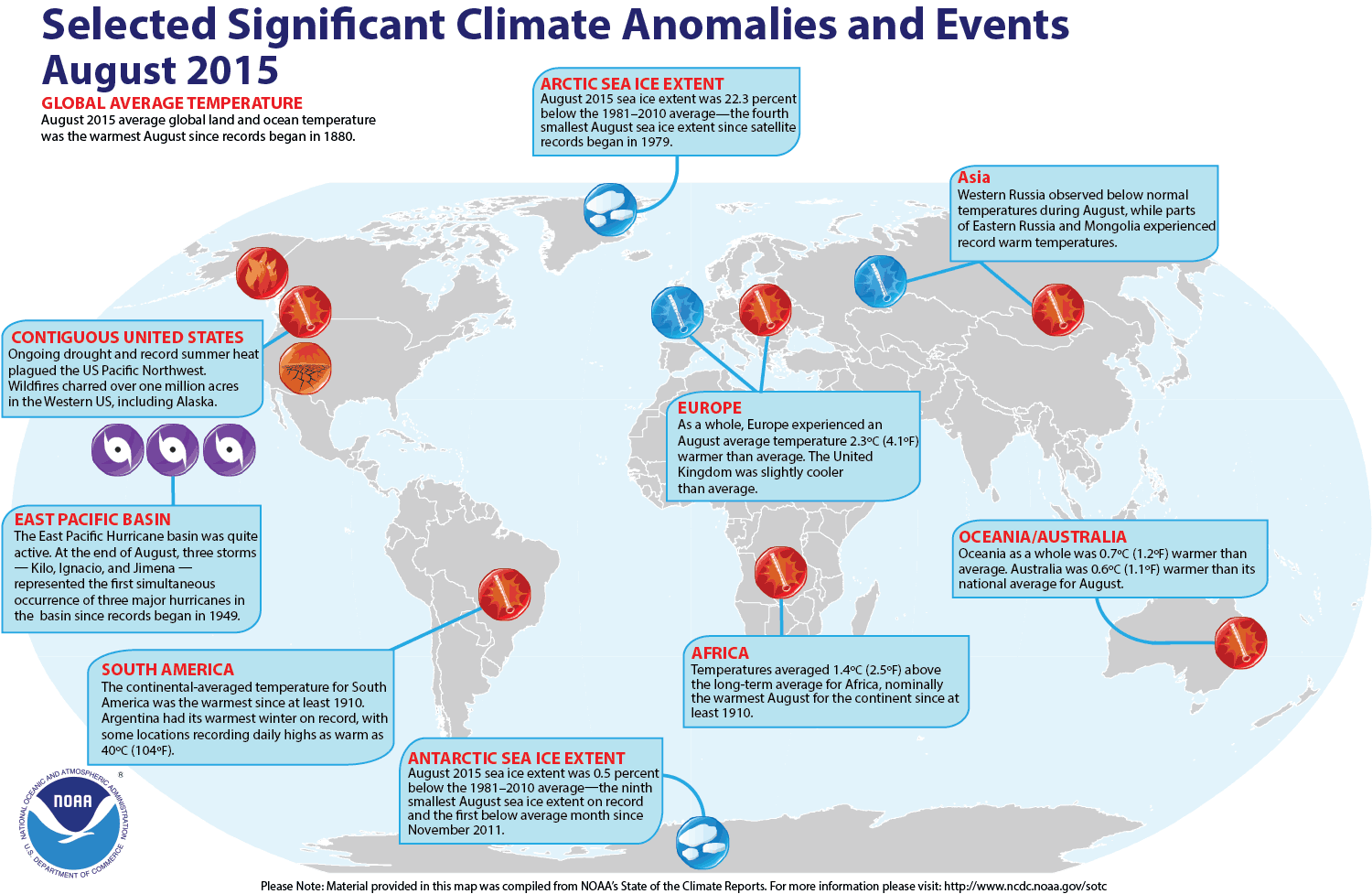
- The global
combined land and ocean average surface temperature for August 2015 was 1.58 Fahrenheit degrees above the 20th-century average (1901-2000) for
the month, which makes last month the warmest August since a sufficiently dense network of global temperature
records began in 1880. When considered separately, the monthly
temperature departure of the ocean
surface was 1.40 Fahrenheit degrees above the 20th-century average, which not only would be a record high for any August in the last 136 years, but represented the largest temperature departure for any month of the year, set the previous month of July 2014. The land surface surface temperature for this recently concluded month also was
the highest August temperature on record, with a monthly temperature that was approximately 2.05 Fahrenheit degrees above the 20th-century average. [NOAA/NCDC
State of the Climate]
- A global map of Selected Significant Climate Anomalies and Events for August 2015 is available from NCEI.
- The global land and ocean average temperature for the
three-months of June, July and August (meteorological summer in the
Northern Hemisphere) 2015 was also the highest for this three-month period
since 1880, as it was 1.53 Fahrenheit degrees above the 20th-century average. The June-August 2015 temperatures for both the ocean and land, when considered separately, were highest for any boreal summer in the last 136 years.
- According to data provided by
the National Snow and Ice Data Center, the average August Arctic sea ice extent was approximately 22.3 percent below the 1981–2010 average, making it the fourth smallest August Arctic sea ice extent since satellite records began in 1979. The August Antarctic sea ice extent was the ninth smallest August extent on record and marks the first month since November 2011 that had below average sea ice extent.
- Assessing likelihood of 2015 becoming Earth's warmest year on record -- In a blog written by researchers at the NOAA National Centers for Environmental Information, the topic of the likelihood of the calendar year of 2015 becoming the warmest year around the globe since sufficiently dense worldwide weather observing networks developed in 1880. Based upon the record-setting global temperatures through the first seven months of the year, together with an ongoing strong El Niño that should continue through the next several months, chances look extremely likely that this year would be a record-setter. [NOAA Climate.gov News]
- An All-Hazards Monitor-- This Web portal provides the user information from NOAA's National Weather Service, FAA and FEMA on
current environmental events that may pose as hazards such as tropical
weather, fire weather, marine weather, severe weather, drought and
floods. [NOAA/NWS Daily Briefing]
- Earthweek -- Diary of the Planet [earthweek.com]
Concept of the Week: Variations in Marine
Sediment Thickness
Sediments are particles of organic or
inorganic origin that accumulate in loose form in depositional
environments such as lake or ocean bottoms. Marine sediments, the
central focus of this week's investigations, have a variety of sources
and exhibit a wide range of composition, size, and shape. Marine
sediments settle to the ocean floor as unconsolidated accumulations but
ultimately may be converted to solid sedimentary rock via compaction
and cementation. The pattern of variations in marine sediment thickness
on the ocean floor confirms some basic understandings regarding marine
geological processes.
Go to the RealTime Ocean Portal and
under "Geological," click on "Sediment Thickness." This map of marine
sediment thickness in the ocean basins was compiled by the National
Geophysical Data Center (NGDC), Marine Geology and Geophysics Division
primarily based on existing maps, ocean drilling, and seismic
reflection profiles. Sediment thickness is color-coded in meters from
violet (thinnest) to red (thickest). Many factors account for the
variation in the thickness of marine sediment deposits including type
and location of sediment sources, sediment transport mechanisms, and
the age of the underlying crust.
According to the map, sediment thickness generally increases
with distance from near the central portion of an ocean basin to the
continental margin. This pattern may be explained by the principal
sediment source and/or the age of the underlying crust. Rivers and
streams that empty into the ocean slow and diverge, releasing the bulk
of their suspended sediment load in coastal environments (e.g., bays,
estuaries, deltas) and onto the continental shelf. Ocean currents
transport sediment along the coast. In some areas of the continental
shelf, massive amounts of sediment accumulate, become unstable, and
flow down the continental slope to the base of the continental rise and
beyond. However, only the finer fraction of river-borne sediment is
swept into the deep ocean waters. Thickening of marine sediments in the
direction of the continental margin may also reflect the aging of
oceanic crust with distance away from divergent (spreading) plate
boundaries where new oceanic crust forms. The older the crust the
longer is the period that sediment rains down on the ocean bottom and
the thicker is the blanket of accumulated sediment.
The map indicates that the thickness of marine sediment
deposits is greater in the continental margin along the Atlantic coast
of North America than along the Pacific coast. The Atlantic coast of
North America is a passive margin; that is, the
continental margin is not affected significantly by tectonic processes
(no plate boundary) and the principal geological processes consist of
sedimentation along with erosion by ocean waves and currents. In fact,
passive margins and relatively thick marine sediment deposits occur on
both sides of the Atlantic. (Passive margins also occur around the
Arctic Ocean and surrounding Antarctica.) On the other hand, the
Pacific coast of North America is an active margin;
that is, the continental margin is associated with plate boundaries and
is subject to deformation by tectonic stresses. Active continental
margins are relatively narrow so that sediment delivered to the coast
by rivers and streams flows directly into deeper water or
trenches—preventing thick accumulations of marine sediments from
building in the continental margin.
Concept of the Week: Questions
- The thickness of marine sediment deposits is greater in the [(continental margins)(deep-ocean
basins)].
- The thickness of marine sediment deposits generally is
greater in [(active)(passive)]continental
margins.
Historical Events
- 21 September 1938...The "Great New England Hurricane"
smashed into Long Island and bisected New England from New Haven, CT
across Massachusetts and Vermont, causing a massive forest blowdown and
widespread flooding. Winds gusted to 186 mph at Blue Hill Observatory
in Milton, MA, and a storm surge of nearly 30 ft caused extensive
flooding along the coast of Rhode Island. The hurricane killed over 600
persons and caused $500 million damage. The hurricane, which lasted
twelve days, destroyed 275 million trees. Hardest hit were
Massachusetts, Connecticut, Rhode Island, and Long Island NY. The "Long
Island Express" produced gargantuan waves with its 150 mph winds. Waves
smashed against the New England shore with such force that
earthquake-recording machines on the Pacific coast clearly showed the
shock of each wave. (David Ludlum) (The Weather Channel)
- 22-23 September 1998...Hurricane Georges raked Hispaniola
leaving over 580 dead in Haiti and the Dominican Republic, due mainly
to flash flooding and subsequent mud slides in high terrain regions.
Damage estimates from the storm exceeded $1 billion (US). (The Weather
Doctor)
- 23 September 1551...The Grand Harbour at Valetta, Malta was
hit by a waterspout that then moved inland and caused extensive damage.
A shipping armada in the harbor about to go into battle was destroyed
by the waterspout killing at least 600 people. (The Weather Doctor)
- 23 September 1815...One of the most powerful hurricanes to
strike New England made landfall initially on Long Island, NY and then
again at Old Saybrook, CT before crossing into Massachusetts and New
Hampshire. Extensive structural damage resulted. Providence, RI was
flooded and six people were killed. This "Great September Gale" was the
worst tempest in nearly 200 years, equal in strength to the Great 1938
Hurricane, and one of a series of severe summer and autumn storms to
affect shipping lanes that year. (David Ludlum)
- 24 September 1493...Christopher Columbus set sail with 17
ships on his second expedition to the New World, reaching the Lesser
Antilles, the Virgin Islands, Puerto Rico and Hispaniola before
returning to Europe in March 1496. (Wikipedia)
- 25 September 1513...Vasco Núñez de Balboa, a Spanish
conquistador-explorer, crossed the isthmus of Panama and reached the
Pacific Ocean, which he christened Mar del Sur (South Sea), claiming
the ocean and all adjacent lands for Spain. (Wikipedia)
- 25 September 1939...A West Coast hurricane moved onshore
south of Los Angeles bringing unprecedented rains along the southern
coast of California. Nearly 5.5 in. of rain drenched Los Angeles during
a 24-hr period. The hurricane caused $2 million in damage, mostly to
structures along the coast and to crops, and claimed 45 lives at sea.
"El Cordonazo" produced 5.66 in. of rain at Los Angeles and 11.6 in. of
rain at Mount Wilson, both records for the month of September. (David
Ludlum) (The Weather Channel)
- 25 September 1956...The world's first transatlantic
telephone cable system began operating (Clarenville, Newfoundland to
Oban, Scotland). Previous cables had been limited to telegraph
transmissions. (Today in Science History)
- 26 September 1580...English seaman Francis Drake returned
to Plymouth, England, in the Golden Hind, becoming
the first British navigator to circumnavigate the globe. He had
commenced his voyage around the world on 13 December 1577 with five
ships, but returned with only one ship. During his voyage in the
Pacific Ocean, he paused near San Francisco Bay and then traveled as
far north as present-day Washington State. He brought back valuable
information about the world's ocean to Queen Elizabeth I. (The History
Channel)
- 26-27 September 1959...Typhoon Vera ravaged Honshu, Japan,
the nation's largest island, leaving over 5000 dead, more than 40,000
injured, 1.5 million homeless and 40,000 homes destroyed. It was
Japan's greatest storm disaster. (The Weather Doctor)
- 27 September 1854...After colliding with the French ship SS Vesta in dense fog, the American Collins Line
steamship Arctic sank with more than 300 people on
board near Cape Race, Newfoundland, marking the first great disaster in
the Atlantic Ocean. (Wikipedia)
- 27 September 1922...Report on observations of experiments
with short wave radio at the Naval Aircraft Radio Laboratory in
Anacostia, DC started US Navy development of radar. (Navy Historical
Center)
- 27 September 1958...A typhoon caused the death of nearly
5000 people on Honshu, the main Japanese island. (Wikipedia)
Return to DataStreme Ocean RealTime Ocean Portal
Prepared by DS Ocean Central Staff and Edward J. Hopkins,
Ph.D.,
email hopkins@meteor.wisc.edu
© Copyright, 2015, The American Meteorological Society.