Weekly Ocean News
DATASTREME OCEAN WEEK ONE: 23-27
January 2012
Items of Interest:
- Check interesting ocean facts -- During
this week, the NOAA Ocean Service website is featuring a variety of
interesting ocean facts, some that are often overlooked. See the
podcast "Making Waves: Top Five Ocean Facts"[NOAA]
- Review of national weather indicates 2011 had
numerous climate extremes in the US -- NOAA scientists
recently announced that the recently concluded 2011 was a
record-breaking year for climate extremes across the United States.
Numerous long-standing records were smashed because of historic levels
of heat, precipitation, flooding and severe weather that were
encountered. Based upon preliminary data, the annual average
temperature across the coterminous United States was the 23rd highest
since relatively reliable climate records began in 1895. Although
precipitation was close to the 20th century average, various areas
across the nation experienced extremes in precipitation, ranging from
drought to flooding conditions. The scientists also announced that two
additional severe weather events, Tropical Storm Lee's landfall on the
Gulf Coast in September and July severe weather outbreak across the
Rockies and Midwest, each resulted in at least $1 billion damage, which
raised the number of billion-dollar disasters across the nation from 12
to 14 events.
Preliminary data also indicated that the average global temperature in
2011 tied 1997 for the 11th highest since global records began in 1880.
[NOAA
News]
Using a slightly different methodology for averaging global surface
temperatures, scientists at NASA's Goddard Institute for Space Studies
(GISS) reported that the global average temperature for 2011 was the
ninth highest reading since 1880. [NASA
GISS]
Ocean in the News:
- Eye on the tropics --- During the last
week, several tropical cyclones (low-pressure systems that form over a
tropical ocean basin) were detected over the tropical South Indian
Ocean.
Cyclone Ethel formed over the waters of the western South Indian Ocean
to the east-northeast of La Reunion Island near the end of the week. As
this tropical cyclone traveled to the south-southwest, it intensified
to become a category 1 cyclone on the Saffir-Simpson Scale. As of this
past weekend, Cyclone Ethel continued to travel southward. For more
information on Cyclone Ethel, along with satellite imagery, consult the
NASA
Hurricane Page.
Several hours later, Cyclone Funso formed over the Mozambique Channel
near the coast of Mozambique. Traveling south off the coast, this
system intensified to a category 1 tropical cyclone on the
Saffir-Simpson Scale. See the NASA
Hurricane Page for satellite imagery and additional
information on Cyclone Funso.
- Additional critical habitat for leatherback sea
turtles designated --NOAA officials announced recently that
41,914 square miles of additional marine habitat was being designated
as critical habitat along the coasts of California, Oregon and
Washington in order to provide protection for endangered leatherback
sea turtles along the US West Coast. [NOAA
News]
- National strategy to respond to impacts of
climate change on plants, fish and wildlife proposed -- The
Obama Administration recently released the first draft of a national
strategy designed to assist resource managers and decision makers over
the next five years in preparation for and response to the current and
future impacts that climate change could have upon plant and animal
species and ecosystems along with the people and economies dependent
upon them. This draft, entitled "National Fish, Wildlife and Plants
Climate Adaptation Strategy," has been prepared in a partnership with
the US Department of Interior's U.S. Fish and Wildlife Service, the
Department of Commerce's National Oceanic and Atmospheric
Administration, and the New York State Department of Environmental
Conservation along with other state, tribal and federal agencies.
Public comment on this draft is invited through early March. [NOAA
News] Note: This link requires Adobe Acrobat
Reader. See below.
- Current La Niña event may be peaking --
Scientists with NASA's Jet Propulsion Laboratory report that the
current La Nina episode, an anomalous pattern in large scale
atmospheric and oceanic circulation patterns typically seen as a colder
than average eastern equatorial Pacific Ocean, appears to be peaking.
They claim that sea surface height data from NASA's Jason-1 and -2
satellites obtained in early January 2012 show a pattern of sea height
that indicates a milder repeat of last year's strong La Niña has been
occurring. [
NASA JPL]
- An All-Hazards Monitor -- This Web
portal provides the user information from NOAA on current environmental
events that may pose as hazards such as tropical weather, drought,
floods, marine weather, tsunamis, rip currents, Harmful Algal Blooms
(HABs) and coral bleaching. [NOAAWatch]
- Global and US Hazards/Climate Extremes -- A
review and analysis of the global impacts of various weather-related
events, to include drought, floods and storms during the current month.
[NCDC]
- Earthweek -- Diary of the Planet [earthweek.com]
Requires Adobe Acrobat Reader.

Concept of the Week: Touring the
DataStreme Ocean Website
NOTE: This Concept for the Week is a repeat of that which
appeared in last week's Weekly Ocean News.
Welcome to DataStreme Ocean! You are embarking on a study of
the world ocean and the role of the ocean in the Earth system. This
unique teacher enhancement course focuses on the flow and
transformations of energy and water into and out of the ocean, the
internal properties and circulation of the ocean, interactions between
the ocean and the other components of the Earth system, and the
human/societal impacts on and responses to those interactions.
Throughout this learning experience, you will be using the DataStreme
Ocean website to access and interpret a variety of
environmental information, including recent observational data. The
objective of this initial Concept of the Week is to
explore features of the DS Ocean website.
On Monday of each week of the course, we will post the current
Weekly Ocean News that includes Ocean in
the News (a summary listing of recent events related to the
ocean), Concept of the Week (an in-depth analysis
of some topic related to the ocean in the Earth system), and Historical
Events (a list of past events such as tsunamis or specific
advances in the understanding of oceanography). When appropriate, a
feature called Supplemental Information-In Greater Depth
will be provided on some topic related to the principal theme of the
week.
You will use the DS Ocean website to
access and download the weekly "Current Ocean Studies" (plus supporting
images) that complement Investigations found in your Ocean
Studies Investigations Manual. These materials should be
available Monday morning. Click the appropriate links to download and
print these electronic Current Ocean Studies and answer forms as well
as your Chapter Progress and Investigations Response forms.
The body of the DS Ocean website provides
links to the Earth System, information on Physical & Chemical,
Geological, and Biological aspects of the ocean, Atmosphere/Ocean
Interaction, the Great Lakes, and extras-a glossary of terms, maps,
educational links, and DataStreme Ocean
information. Following each section is a link to other sites that
examine the various subsystems of the Earth system. Let's take a quick
tour to become more familiar with the DS Ocean
website.
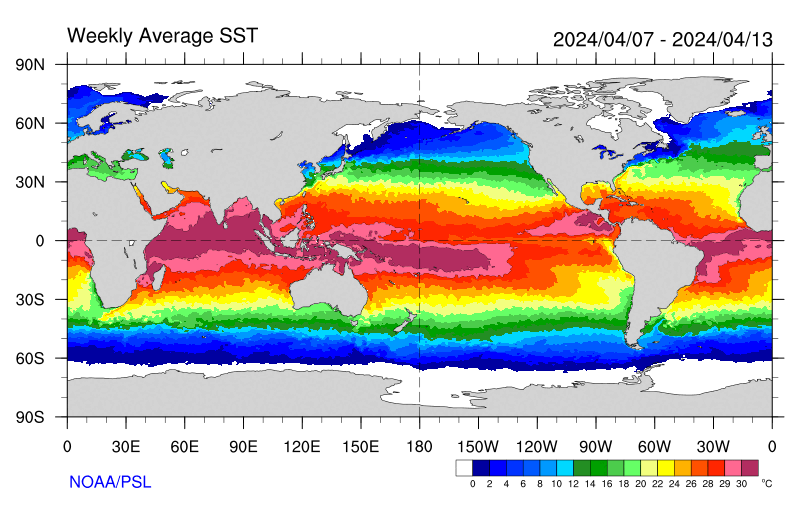
Under Physical & Chemical, click
on Sea
Surface Temperatures. This image uses a color scale
to depict the global pattern of sea surface temperatures (SSTs) (in
degrees Celsius) averaged over a recent 7-day period and based on
measurements by infrared sensors onboard Earth-orbiting satellites.
(Depending on your browser, you may have to place your mouse cursor on
the slide bar to the right and scroll down to view the entire image.)
Compare SSTs in the Northern Hemisphere with those in the Southern
Hemisphere. Return to the DS Ocean website.
Under Geological, click on Current
Earthquake Activity. The USGS Current World
Seismicity page provides a global map of the locations of seismic
(earthquake) events color-coded for the past seven days. The size of
the squares represents the magnitude of recent earthquakes. Note how
earthquakes are concentrated along the margin of the Pacific Ocean.
Details of recent earthquakes can be found by clicking on their map
squares. Return to the DS Ocean website.
The ocean is home to a wide variety of habitats and organisms.
Under Biological, click on Ocean
"Color" (Productivity). This is
a satellite-derived (SeaWiFS) color-coded map of biological
productivity in the surface waters of the world ocean is averaged from
October 1978 to date. Orange and red indicates the highest
productivity, while dark blue and violet indicate the lowest
productivity. Note the vast areas of relatively low productivity over
the central regions of the subtropical ocean basins. Individual months
within this period may be chosen for viewing. Now return to the DS
Ocean website.
Under Atmosphere/Ocean Interaction, click
on TRMM
Tropical Rainfall. The TRMM (Tropical
Rainfall Measuring Mission) page includes color-coded maps of
the Monthly Mean Rainrate (in mm per day) across the tropics for the
last 30 days ending on the present date. Changes in rainfall are linked
to large-scale shifts in the atmosphere/ocean circulation in the
tropics. Now return to the DS Ocean website.
Take a few minutes when you have time to browse the other data
and information sources available via the DS Ocean
website. You should "bookmark" ("favorites") this page on your
computer. Return frequently to learn more about the many resources on
the ocean in the Earth system. Bon voyage!
Concept of the Week: Questions
- The latest global sea surface temperature map indicates
that SSTs are generally higher over the [(western)(eastern)]
tropical Pacific Ocean.
- The USGS map of Current Earthquake Activity indicates that
earthquakes appear to be more common along the [(east)(west)]
coast of North America.
Historical Events
- 26 January 1700...The Cascadia Earthquake (magnitude 9)
took place off the coast of British Columbia, as evidenced by Japanese
records. Landslides and a tsunami destroyed many Native American
villages along the coasts of Washington, Oregon and British Columbia,
including Vancouver Island. Japanese written history tells of a massive
tsunami striking fishing villages the next day along the coast of
Honshu, killing hundreds. (Wikipedia) (Today in Science History)
- 26 January 1983...The California coast was battered by a
storm, which produced record high tides, thirty-two foot waves, and
mudslides, causing millions of dollars in damage. The storm then moved
east and dumped four feet of snow on Lake Tahoe. (22nd-29th)
(The Weather Channel)
- 28 January 1946...Canada's greatest sailing ship, Bluenose,
foundered on a Haitian reef; all hands were saved. Her likeness remains
on the Canadian ten-cent coin. (Wikipedia)
- 28 January 1969...A series of storms that battered Southern
California from the 18th to the 28th
led to $125 million damage in the Los Angeles Basin, along with
approximately 9 storm and traffic-related deaths in California. Twenty
feet of water covered Sherman Island, a region that contains more than
10,000 dike-protected agricultural acres, when a dike failed. (Accord's
Weather Guide Calendar)
- 28 January 1971...A waterspout swept into Hawaii's Kailua
Bay, then into the business and hotel district of Kailua-Kona,
destroying or severely damaging a number of buildings including 40
apartment units and collapsing a 6-story hotel under construction.
Amazingly, only four people were injured. (Accord's Weather Guide
Calendar)
- 29-30 January 1966...A hurricane that struck Samoa was
responsible for 50 deaths, destroyed more than one-third of the homes
and damaged the remainder. As many as 50,000 people were left homeless.
Swains Island was leveled by the hurricane. Winds gusted to 100 mph at
Pago Pago. (Accord's Weather Guide Calendar)
- 29 January 1983...A series of Pacific coast storms finally
came to an end. The storms, attributed in part to the anomalous
ocean-atmosphere phenomenon, "El Niño," produced ocean swells 15 to 20
feet high that ravaged the beaches of southern California. Much of the
damage was to homes of movie stars in the exclusive Malibu Colony. (The
Weather Channel)
Return to DataStreme
Ocean Website
Prepared by DS Ocean Central Staff and Edward J. Hopkins,
Ph.D., email hopkins@meteor.wisc.edu
© Copyright, 2012, The American Meteorological Society.